THE WISDOM OF DESIRE ~ The Egalitarianization of Inequality
I know. It feels like you’ve been asleep for a long time now, and you keep asking yourself how things ended up this way. Everyone is trying to figure it out, with books and studies popping up faster than toadstools after a rainstorm. The one thing I’m really starting to notice, however, is a threatening and disquieting social movement: the egalitarianization of inequality.
In other words, the social changes that so much of my generation fought, marched, and got arrested for—civil rights, gay rights, gender rights—have met with an equal and opposite movement that is just as widespread, and one that purports to be just as “egalitarian” at its core. At one point, we were working towards opportunities for all. Now, we seem to be “comfortable” (one of my favorite buzzwords in business Newspeak) with inequality.
The statistics on it are scary: a majority of people in the U.S. now believe that we have hit about as much “equality” as we are going to get. According to a December 2011 Gallup poll on attitudes towards inequality, 54% of Americans believe that income inequality is an “acceptable part of our economic system.” This is a 9% increase since 1998. So things are equal, just, and appropriate, and if you don’t measure up it’s own your fault, sucker!
Back in the Clinton era, when the new Ultra-Libertarianism (pace Ron Paul) was rearing it’s pretty head, I coined the term IGMNYGY (pronounced I-GUM-NIGGY), which stands for I got mine, now you get yours! This was similar to another buzzword from that time: NIMBY (Not in My Back Yard!), and it suited a period of expansion and short-sighted economy and culture. You could get as rich as you wanted, even if a lot of your wealth was only on paper and could disappear at any minute. Still, somebody had to be left with the goodies in the end, and it might as well be you (or me), but definitely not him or her—the poor schnorers out on the street who just forgot to get rich.
I credit a timeless corporate message for getting us to this point: Winning is not everything, it’s the ONLY thing. You win, you get the Lexus; you lose, you get McDonald’s. But what’s even stranger is the notion that you don’t lose with McDonald’s because McDonald’s is still as American as the Lexus. In fact, the only people who lose these days are those who aren’t American at all. This brings us the to rabid anti-immigrant sentiment in this country, though anyone who has ever worked in construction, agriculture, or tourism knows that without an immigrant population, much of American business would collapse. Who the hell else is gonna shingle your roof, clean out your chimney, wash your dishes, or make your bed at Motel 6?
So we have the charming idea that winning and losing is all the same thing: both are all-American, and the more media attention it gets, the more American it is. Daring to disagree with this economic structure—and its strange handmaiden the “culture”—means you don’t deserve to be in it anyway.
If all of this sounds as cold as Newt Gingrich’s testicles and even more Ayn Randian than she herself could stand, you’re right. And the thing that’s really peculiar about it is how young people have bought into it with such delight. It is now cool to not only ignore your neighbor (because you’re too busy on your iPhone), but to genuinely loathe him. Part of this is from being simply overworked: the stakes are now too high (like your rent), the fall too hard (I see way too many people who look just like me sleeping on cardboard), and the competition too cut-throat. Even our beloved billionaire mayor gets a whiff of it every now and then, acknowledging that there are “real people” out there beyond the Upper East Side.
Still, the idea that if you really did deserve to be in the “in crowd” (the Upper 1%, the big winners of the Lottery of Life) then you’d be in it, is rampant. And deadly. Twice as many people now die from suicide in this country than murder (who the hell ever thought we’d reach that stat?). And so we’ve arrived at a static plateau of horrifying nihilism, minus the groovy existential fun of the ’50s, when there were beatnik poets and bongo drums to keep us entertained.
The fun has been drained out of the system because there is no alternative. Nihilism is great when you have some bozos around who still believe in optimism. But I’m afraid those delightful clowns, the ones who really move the scenery back and forth in the great show of life, have left the stage.
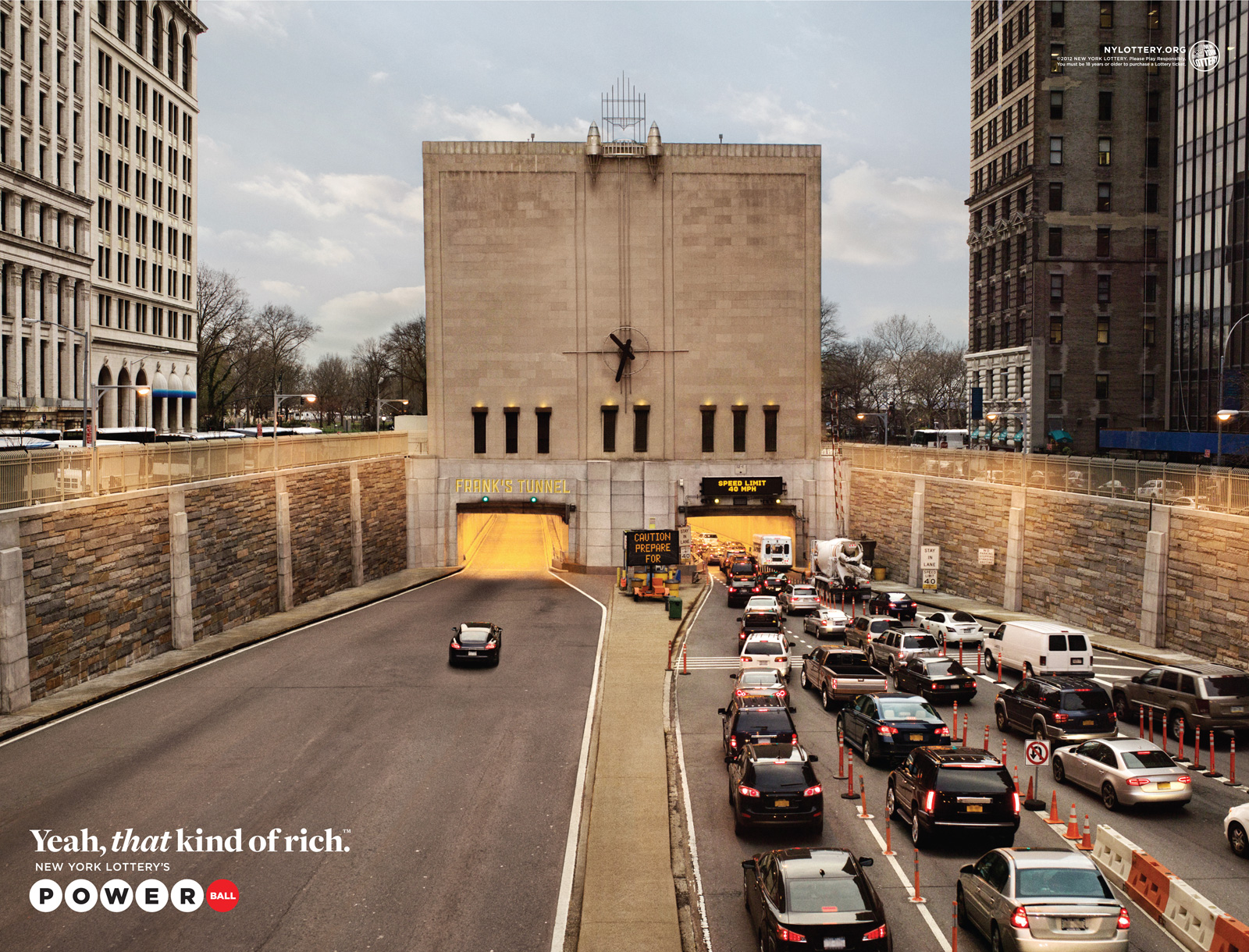
Wouldn't you like to be part of the 1%? Just one of the many posters for New York Lottery's new "Yeah, that kind of rich" campaign.
 Perry Brass’s latest book, The Manly Art of Seduction, is an IPPY Gold Medal Winner and very much about the “Wisdom of Desire.” His next book, The King of Angels, is set in 1963 Savannah and is described as “a gay, Southern, Jewish coming of age story.” For more information, check out his website HERE.
Related:



Recent:

Not A Souvenir.
For people who still talk to strangers.

GOT A QUESTION FOR NEW YORKERS?
Send it in. We may take it to the streets.
Recent:
NOT A SOUVENIR.
For people who still talk to strangers.