Devon Rodriguez and the Art of Being Seen
God bless Devon Rodriguez.
I mean that.
A kid from the Bronx starts drawing strangers on the subway, puts the videos online, and somehow becomes one of the most visible artists in the world.
Tens of millions of followers. Celebrity portraits. Advertising campaigns. Prints. Merchandise. And now a bestselling memoir.
That’s a long way from sketching strangers on the subway.
Good for him.
But I keep coming back to one question:
How the hell did this happen?
Not because Devon Rodriguez isn’t talented. He is. The guy can draw. He makes very good portraits.
But New York City is filled with extraordinarily talented artists. So is the world.
Painters. Sculptors. Photographers. Filmmakers. Performance artists. People working with sound, light, architecture, public space, gardens, garbage. People spending their lives trying to make something nobody has ever seen before.
And Devon draws portraits of strangers.
He shows them the drawing.
They react.
Sometimes they cry.
Sometimes he asks:
“What’s your biggest dream?”
And millions of people watch.
It almost hurts my brain in its simplicity.
But maybe the simplicity is exactly the point.
Devon had been sketching people on the subway long before TikTok entered the picture.
Then came 2020.
COVID.
Everybody stuck inside. Everybody staring at a phone.
He started posting his work.
One video took off. Then another.
There was luck involved.
Right person. Right city. Right platform. Right moment.
But luck only matters if you recognize it when it arrives.
Devon recognized it.
He understood that people weren’t responding just to the drawing.
They were responding to the reveal. That moment when a complete stranger realizes somebody has been looking at them closely enough to draw their face.
Devon himself has said, “It’s not even about the portrait, it’s about the person’s reaction.”
I think that’s fascinating.
Because once it isn’t really about the portrait anymore, what exactly is the art?
Is it the drawing? The reaction? The conversation? The whole encounter?
Or is it the fact that millions of people are watching?
Maybe Devon became something more interesting than a portrait artist without necessarily setting out to.
He turned the New York City subway into his gallery, ordinary New Yorkers into his subjects, and their reactions into something people all over the world wanted to see.
That’s quite a trick.
And maybe the genius wasn’t creating the accident.
Maybe the genius was recognizing it.
Then came everything else.
Followers became visibility.
Visibility became fame.
Fame became advertising.
The brands. The products. The courses.
The business of Devon Rodriguez.
And something else has happened along the way.
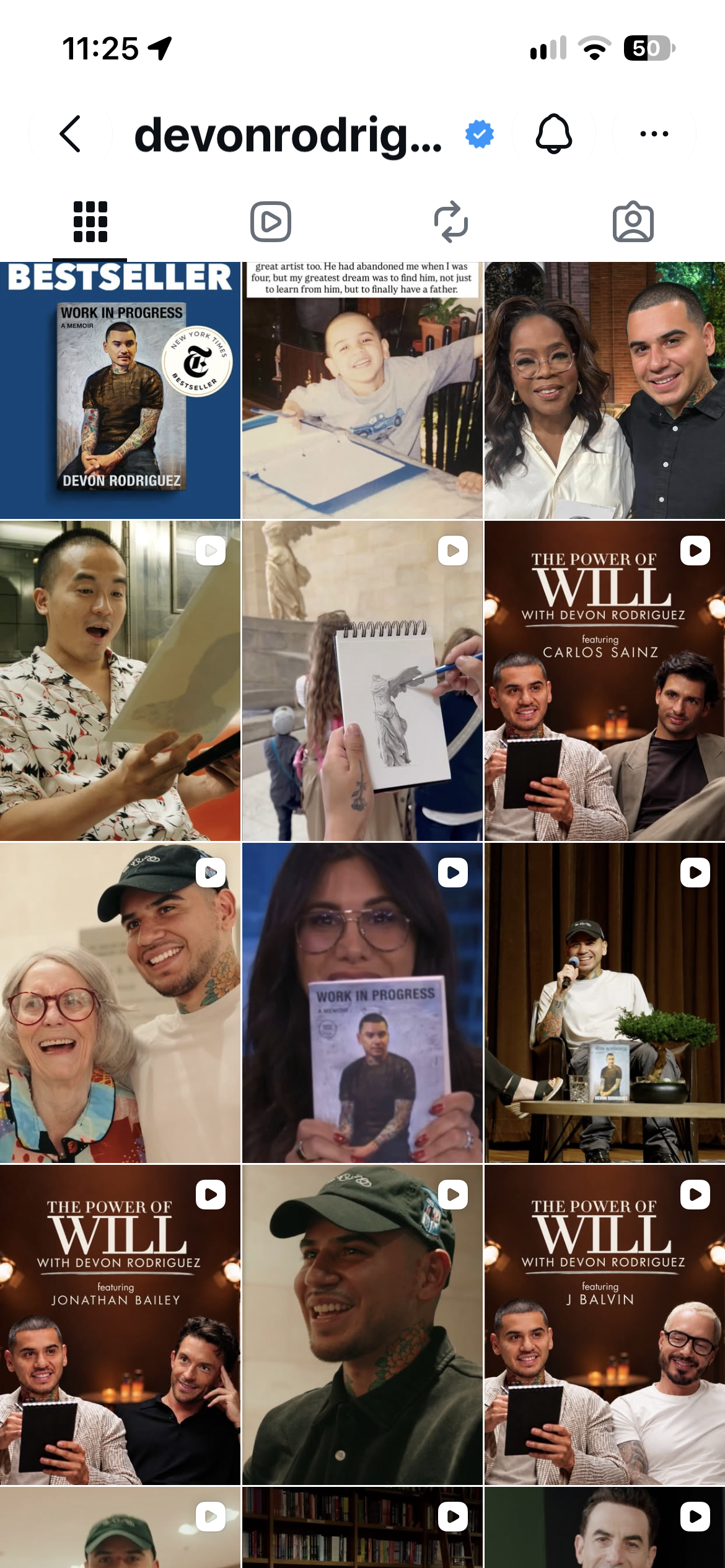
Look at his Instagram page today. There’s Devon with Oprah, promoting his bestselling memoir, appearing with celebrities. The subway portraits are still there, but something has changed. The artist who became famous by making ordinary strangers the center of attention has become the center of attention himself. He made his name by making other people feel seen. Now the story is increasingly about Devon Rodriguez.
And why not?
He found an extraordinary moment in his life and capitalized on it.
Somewhere along the way, the artist became the celebrity.
And now he’s an author.
His memoir, Work in Progress, explores a life considerably more complicated than his social media videos might suggest.
He grew up in the Bronx under difficult circumstances. Drawing became something he could escape into.
A ninth-grade art teacher reportedly encouraged him to start sketching passengers on the subway.
Think about that.
A teacher encourages a kid to draw strangers on the train, and years later that kid has millions of followers around the world and a published memoir.
I haven’t read it yet, but I think I will.
Because there may be a much more complicated story behind those simple little videos.
Which brings me back to something I’ve been thinking about.
What happens culturally when somebody becomes this visible?
Because visibility has a strange way of turning into importance.
Someone becomes known as “the most followed artist in the world,” and after a while people can start confusing that with being one of the greatest artists in the world.
Those are two very different things.
I’m not questioning Devon’s talent. I’m questioning how we measure these things.
There are artists working in New York right now doing extraordinary, original, difficult work who will never have a fraction of his audience.
Some will spend their entire lives working in relative obscurity.
Meanwhile, Devon draws a stranger, shows them the portrait, captures their reaction, and millions of people tune in.
Portrait.
Reveal.
Reaction.
Repeat.
Social media loves that.
It’s familiar. It’s immediate. It’s emotional. You understand what’s happening before your thumb has a chance to move to the next video.
But art isn’t always that simple.
Sometimes it takes time. Sometimes it makes you uncomfortable. Sometimes you walk away wondering what the hell you just saw.
And sometimes it takes years before anybody recognizes its importance.
Warhol understood mass production.
Banksy understood public space.
Devon Rodriguez understands attention.
And maybe he understands something even more important.
People want to be seen.
That part I understand.
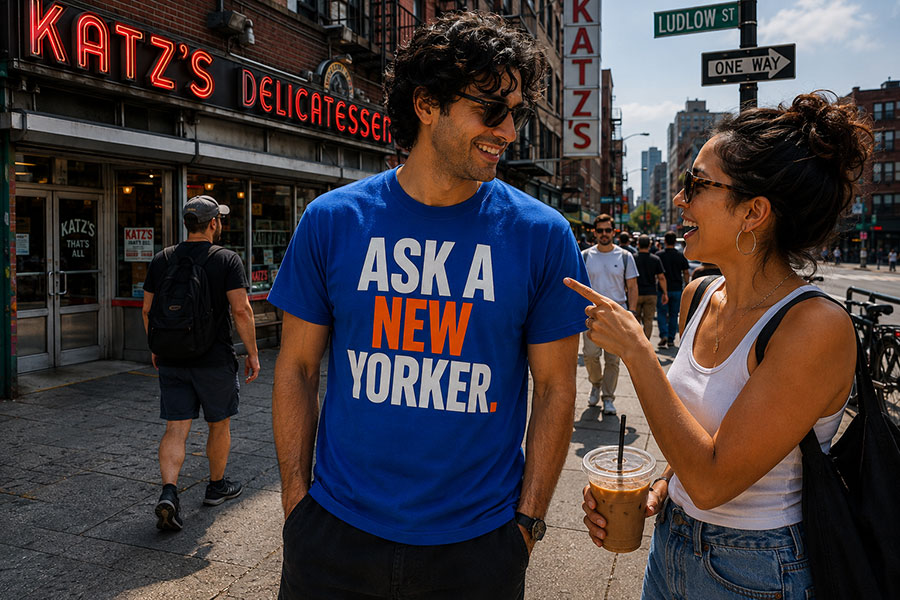
Since 1999, Ask a New Yorker has been built around an equally simple idea.
Talk to strangers.
New Yorkers are often portrayed as cold, rude and disconnected.
We can be abrupt. We can be impatient. We have places to go. There’s urgency to life here.
But we’re also curious. Generous. Funny. Helpful. Loving.
And I’ve always believed that if you ask a New Yorker a question, you’re going to get a fucking answer.
It might not be the answer you expected.
It might not even be the answer you wanted.
But you’ll get an answer.
And sometimes you’ll get something extraordinary.
Maybe that’s why Devon’s work interests me so much.
He understands that the stranger isn’t background.
The stranger is the story.
That’s something I’ve believed since I started Ask a New Yorker in 1999.
You don’t necessarily need a celebrity, an expert, or somebody with an impressive résumé to have an interesting conversation.
Sometimes all you need is the person standing next to you.
Ask a New Yorker has always been about creating that moment of connection.
Where people still talk to strangers.
And if you ask me:
“What’s your biggest dream?”
I’m living it.
Kennedy Moore
Ask a New Yorker
Related:

Recent:

Not A Souvenir.
For people who still talk to strangers.

GOT A QUESTION FOR NEW YORKERS?
Send it in. We may take it to the streets.
Recent:
NOT A SOUVENIR.
For people who still talk to strangers.